Frameworks / The Context Layer
The model is what you rent. The context is what you build — and it is the part that refuses to leave.
Every AI deployment has two parts. The foundation model is the visible one, and increasingly the portable one: swapping one model for another is becoming an engineering task, not a strategic one. The context layer is everything an organisation builds around the model. It is where the actual institutional knowledge of a deployment lives — and almost nobody is governing it as a position or pricing it as a risk.
What sits in it
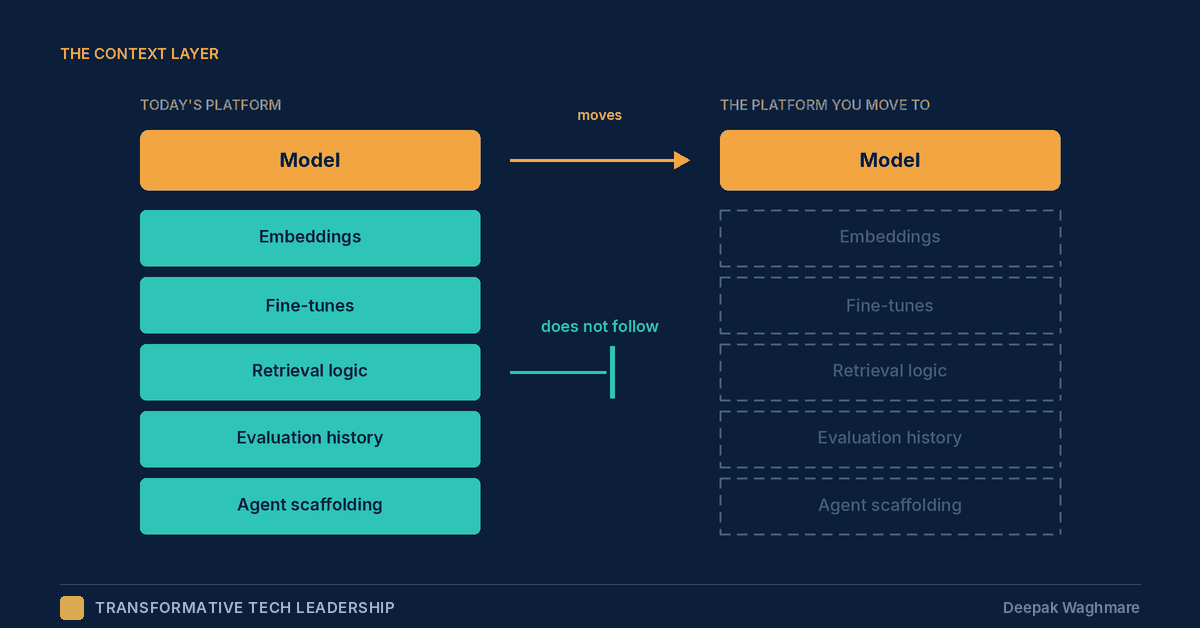
The embeddings generated against one model’s representation of meaning. The fine-tunes. The retrieval logic tuned to one vendor’s quirks. The evaluation history that tells you whether the system is getting better or worse. The agent scaffolding wired into one platform’s tools and permissions.
None of these is a bad decision. Each is reasonable when it is made. Together they set into something that only runs well in one place.
Why nobody sees the whole of it
The context layer hides differently depending on where you stand. At the workload, it hides inside architecture, and engineering sees it first — usually without the vocabulary to escalate it as anything other than technical debt. At the organisation, it hides inside capability: teams, processes and approvals form around one platform’s way of doing things. At the sovereign altitude, it hides inside assumptions about jurisdiction — where the context physically sits, whose law governs it, and who can compel access to it.
Each altitude has an owner: engineering, the operating model, risk and legal. The exit cost is the sum of all three. Nobody owns the sum.
How to see it in the field
It is rarely found in a strategy review. It surfaces sideways. A vendor conversation reprices something that was assumed to be fixed. Or a team tries to move a working use case to a different platform and finds that the model moves in a week while the context stays behind. Either way, the organisation learns its exit cost the same way it learned its egress cost: after the fact.
Holding it as a position
The point is not to avoid dependency. Depending on a platform is often the right call, and a deep commitment can be worth every dollar of the exit cost it creates. The point is to choose it. A leader who knows what leaving would cost, and accepts it, holds a position. A leader who discovers it at renewal holds a liability.
The test is one question: if the board asked tomorrow what it would take to leave, who could answer — and how long would it take them to find out?
Part of the Frameworks series. First argued in You Don’t Have a Cost Problem. You Have a Dependency Problem. Related: the Workload Sovereignty Matrix and the Intelligence Control Stack.