The Exit Multiple, and the one decision it will never make for you.
On 12 January 2027, charging a customer to switch cloud providers becomes illegal across the EU. Egress fees for the switch go with it.
Most boards will hear that as the cost of leaving falling. It is nothing of the kind. In my last edition I argued that egress was never the problem. It was the receipt: the moment a dependency became visible. Regulation is about to cancel the receipt. The dependency stays exactly where it was.
That is EU law, with narrow carve-outs for some legacy contracts still under negotiation, and I would not assume it follows a workload to Singapore or Mumbai. But it changes the question a board anywhere can fairly ask. If the fee was never the real cost of leaving, what is, and does anyone in the building know?
Staying is priced. Leaving is guessed.
Every AI deployment arrives with a price for staying: inference run-rate, licences, support. It has a budget line and a quarterly review.
The price of leaving has no line. It gets assembled when the question becomes real, in a hurry, by whoever is asked, from five different functions. My last edition ended on the board’s second question: who could answer, and how long would it take them to find out? Where leaving has never been priced, the honest answer is that nobody could, and finding out would be the project.
An exit cost you can only learn by trying to leave is not a cost. It is a surprise with a start date.
The Exit Multiple
The fix is unglamorous: put leaving on the same footing as staying. One ratio, per workload.
Exit Multiple = total cost to leave ÷ annual AI run-rate.
Read it as the years of running cost you would spend to get out. A workload that costs $2 million a year to run and $3 million to exit has a multiple of 1.5. (Illustrative figures, not a benchmark.)
The ratio matters more than either number. An absolute exit cost means little without scale. As a ratio it compares workloads and vendors, and, more important, it moves. A multiple that climbs quarter after quarter is a dependency accruing in plain sight.
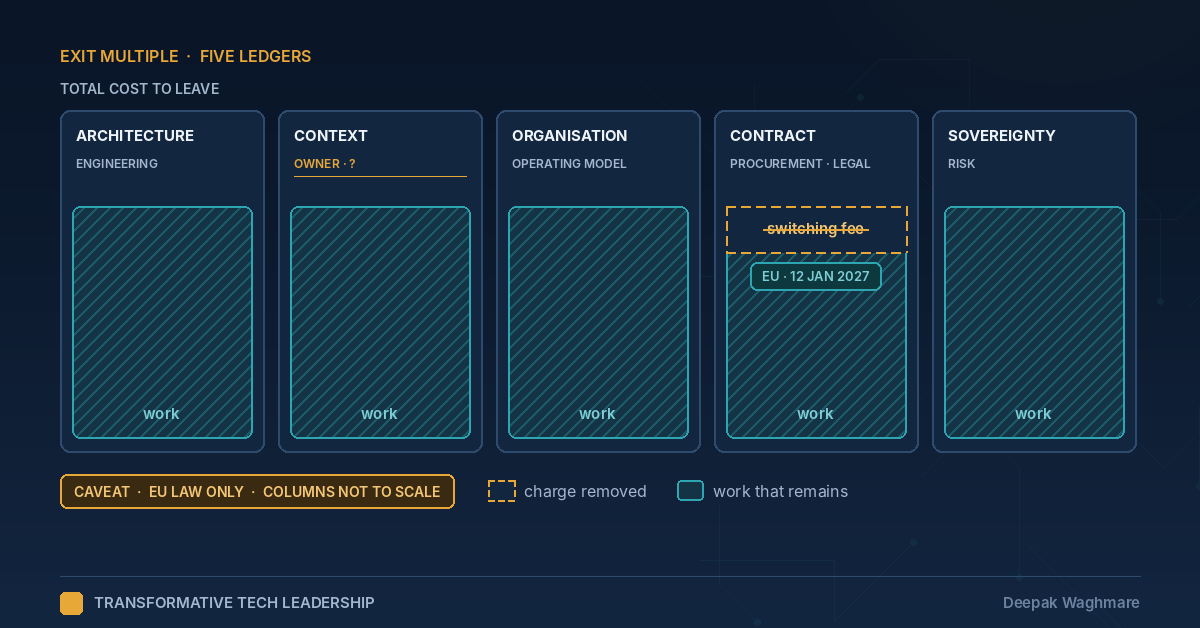
The top of that ratio is not one number. It is five ledgers, and each has a different owner:
- Architecture: what must be rebuilt. Pipelines, integrations, orchestration. Engineering owns it.
- Context: what must be regenerated or re-earned. Embeddings, fine-tunes, retrieval logic, evaluation history, agent scaffolding. Almost nobody governs it.
- Organisation: what people must relearn. Skills, processes and approvals that formed around one platform. The operating model owns it.
- Contract: what leaving triggers. Commitments, notice periods, penalties, data return. Procurement and legal own it.
- Sovereignty: what jurisdiction requires. Where the workload may run, under whose law, with whose regulator’s approval. Risk owns it.
One line out of one ledger
The 12 January rule removes a charge from the Contract ledger. The other four ledgers are work, and work does not become free because the invoice did.
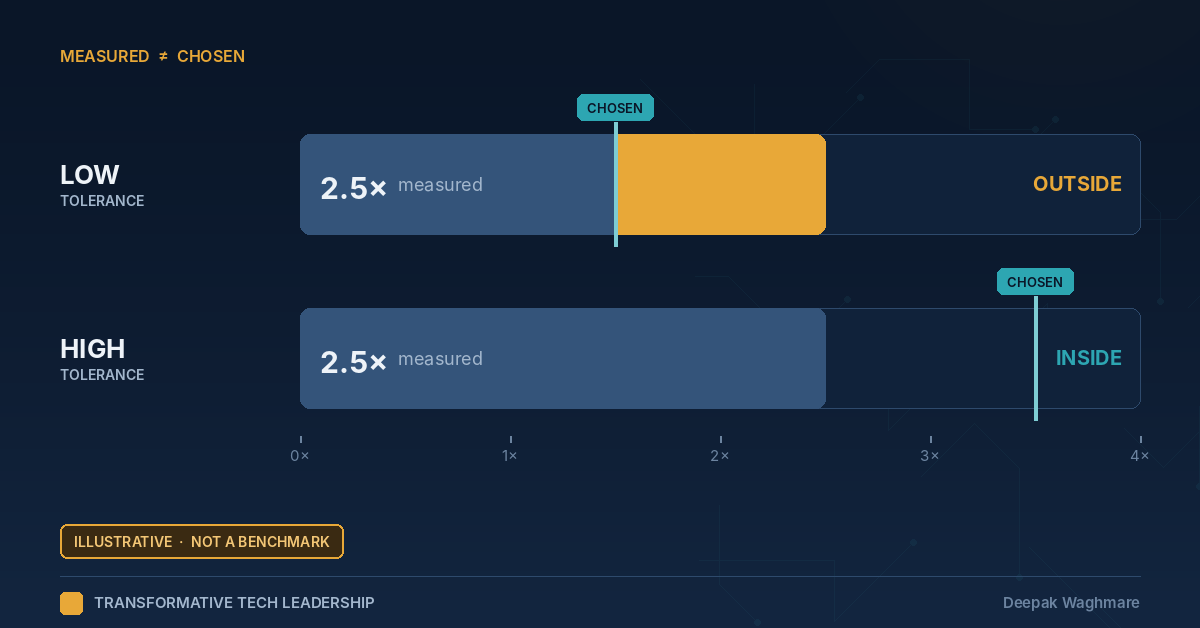
A multiple is measured. A tolerance is chosen.
The wrong conclusion is within reach, so let me correct it now: the multiple is not a verdict.
Once leaving has a number, the number starts to sound like an answer. Portable, leveraged, captive: the bands read like a risk rating, and risk ratings have a way of making a decision feel already made.
But where those lines fall is not an engineering question. Two organisations can hold the same multiple of 2.5 and be right to disagree about it. One is buying speed with open eyes. The other answers to a regulator, or a board, that will not accept it. The arithmetic is identical. The tolerance is not.
This is exactly what automation will offer to settle for you. An agent can inventory an estate and return a multiple by Friday. It will happily propose the bands as well. What it cannot do is decide which dependency your organisation is willing to hold, because that turns on what the organisation is for, what speed is worth to it, and what it could survive losing. Those are the questions a leader is paid to own.
Estimate in ranges. Review on a date.
Two disciplines keep the number honest.
First, give a range, not a point. A multiple of 1.5 to 3 is truer than 2.1, and a leader who quotes 2.1 is claiming a precision nobody in the building has. The width of the range is information too: it tells you which ledger to look at first.
Second, treat the tolerance as a conviction with a review date. Set it, write down who set it, and revisit it when the multiple, the vendor or the regulation moves.
One more thing, since I sit at an infrastructure company. The multiple applies to what my own company sells too. A private AI stack on your own floor has an exit multiple: hardware, skills and context bind there too. None of this is an argument for leaving anywhere. Last edition separated a position from a liability, and the multiple is how you tell which one you hold.
Priced late. Decided anyway.
An organisation I work with in APJ recently set out to assess its cloud concentration risk. The question looked simple: what would it take to reduce the dependency? The answer was not.
Much of the application stack ran on cloud-managed services, and the lock-in came from those services. The working assumption had been an exit multiple near 1.5. The review put it nearer 2.5, and the gap was the cost of re-architecting the applications. (Illustrative figures to show the shape, not the client’s.)
They did not leave, and they did not look away. We worked around the dependency and designed a hybrid instead. The finding did not make the decision. It made the decision unavoidable.
The part no tool will keep current
Tools will keep the multiple current. They will draw the bands, flag the drift, and tell you the day it crosses a line. What they cannot tell you is where the line belongs. That was always the leader’s to set.
The multiple can be measured by anyone. What it is allowed to be belongs to whoever signs the renewal.

Your turn: for the AI workload that matters most in your estate, could someone hand the board a range for its exit multiple by the end of this week? And would they know who to ask first?