A pilot that fails invites scrutiny. A pilot that succeeds suppresses it — and that is usually the moment judgment quietly leaves the room.
The most dangerous moment in your AI programme is not the pilot that fails. It is the one that succeeds.
I have watched this across APJC — in boardrooms in Singapore, on factory floors in India, in banks across Southeast Asia. The pilot lands. The room is genuinely impressed. And the leader, carried by real momentum, approves the scale-up on the spot.
It feels decisive. It is usually the moment judgment quietly leaves the room.
MIT’s The State of AI in Business 2025 put a number on the consequence: of $30–40 billion in enterprise GenAI investment, roughly 95% of initiatives showed zero measurable return. The figure has been contested on methodology, and it deserves that scrutiny — though the study behind it reviewed over 300 disclosed initiatives, 52 organizational interviews and 153 executive surveys. And its central finding is the part leaders should sit with: most enterprise tools fail not because of the underlying models, but because they do not adapt, do not retain feedback, and do not fit daily workflows.
That is not a technology finding. It is a leadership finding.
A demo is a curated result
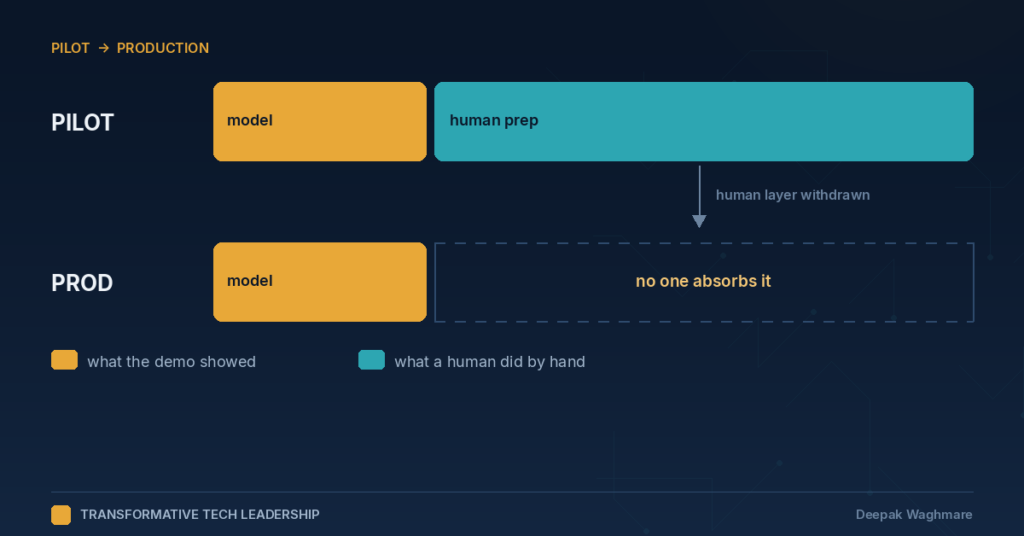
Behind every clean pilot, a person did the hard part by hand.
Someone pulled the data. Cleaned it. Resolved the records that three systems each define differently. Chose the use case with the clearest path and the most cooperative dataset. None of this is dishonest — it is how you prove a concept quickly. But it means the pilot ran on a version of reality that a human manufactured.
The model performed beautifully. Of course it did. It was working on data someone had already made coherent.
So the pilot proved something real, just not the thing most rooms think they approved. It proved the technology works when a human has already absorbed the mess.
And here is the trap: the more impressive the demo, the harder it becomes to ask the uncomfortable question. Failure invites scrutiny. Success suppresses it. The same room that would have interrogated a stalled pilot gives a win a pass — and the leader has to do the least natural thing in the moment, which is slow down while everyone else wants to accelerate.
Production removes the human who was absorbing the difficulty
Scaling does not add difficulty on top of the pilot. It withdraws the person who was quietly holding it together.
Now the system meets the actual estate. The same customer represented four ways across four systems. The source of record that is authoritative in theory and stale in practice. The feed that arrives late one day in five. Work that one analyst did manually to make a demo possible now has to happen continuously, at scale, with nobody in the loop to smooth it over.
That work does not appear on the approval slide. It is the initiative.
A version of this plays out repeatedly. A team builds a GenAI assistant for customer account queries. In the pilot it is excellent — faster and more precise than the process it supports. Leadership approves the scale-up immediately. Then it stalls for months, and not because the model degraded. In production, “account status” is not one thing. Billing says active. Provisioning says suspended. CRM says something six weeks old. In the pilot, an analyst had silently picked the right source for every test case. In production there is no analyst — and no agreed answer to which system tells the truth.
The model was never the problem. The AI was simply the first system honest enough to expose a question the enterprise had never answered for itself.
The question that separates reacting from leading
When a pilot succeeds, the instinct is to ask: can we scale this?
Wrong question. It assumes the demo and the deployment are the same activity at different volumes. They are not.
The leadership question is: what did we do by hand to make this work — and what would it take to never do it by hand again?
That answer is the real scope, the real cost, and the real timeline. It is almost never on the slide that got approved. A leader who asks it does not kill momentum. They aim it.
The same study found something worth holding alongside this: externally partnered deployments reached production roughly twice as often as internal builds — about 67% against 33%. Read that carefully. It is not an argument for outsourcing. It is evidence that the constraint sits in integration discipline and operating capacity, not in model quality. Everyone has access to the same models. Not everyone has done the work to hold them.
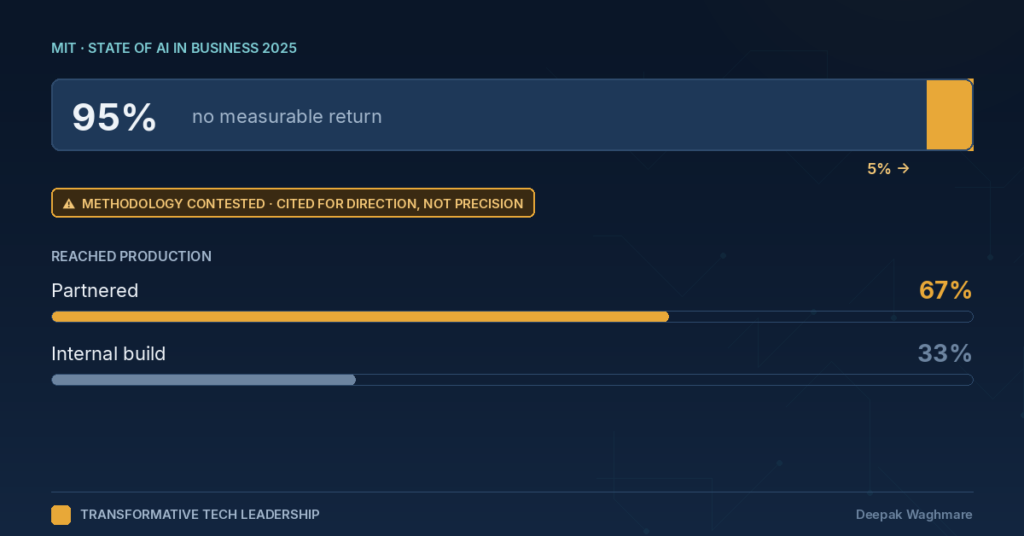
MIT’s own summary of what separates the two groups is almost the whole argument in one line: the organizations crossing the divide are the ones that demand process-specific customization and measure outcomes, not demos.
The leadership learning
AI keeps making leaders the same offer: let the impressive output stand in for the hard judgment.
The pilot says approve me. The dashboard says I have got this. The model says trust the number.
Transformative leadership in this era is largely the discipline of declining that offer at the right moments. Not rejecting the tool — using it fully, while refusing to let it make the decision that is yours to make. Technology can produce the demo. It cannot tell you whether your organization is ready to hold it. That judgment does not scale, does not automate, and does not delegate.
The strongest leaders I work with treat a successful pilot not as permission to scale, but as the clearest map they will ever get of the work they have been deferring for years.
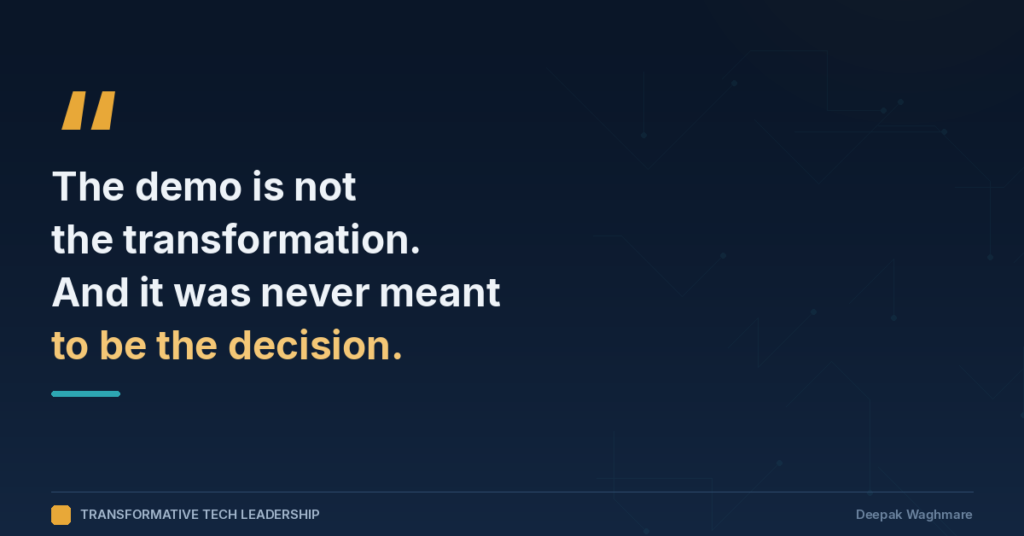
The demo is not the transformation. And it was never meant to be the decision.