The Change / See / Stop test, and the one decision no region selector makes for you.
For a long time, the sovereign AI conversations I sat in across Asia Pacific ended at the same checkmark: the data stays in the country.
That checkmark is losing its authority.
On my recent field trips across the region, the question healthcare and financial services customers brought to the table was not where their data sits. It was how to protect their IP. And they were specific about what that meant: access to their data, and access to their processes.
It is no accident the question came from those two sectors. In both, the process is the product: how a credit decision is made, how a claim is assessed, how a patient is triaged. Copy their data and you have their records. Copy their process and you have their business.
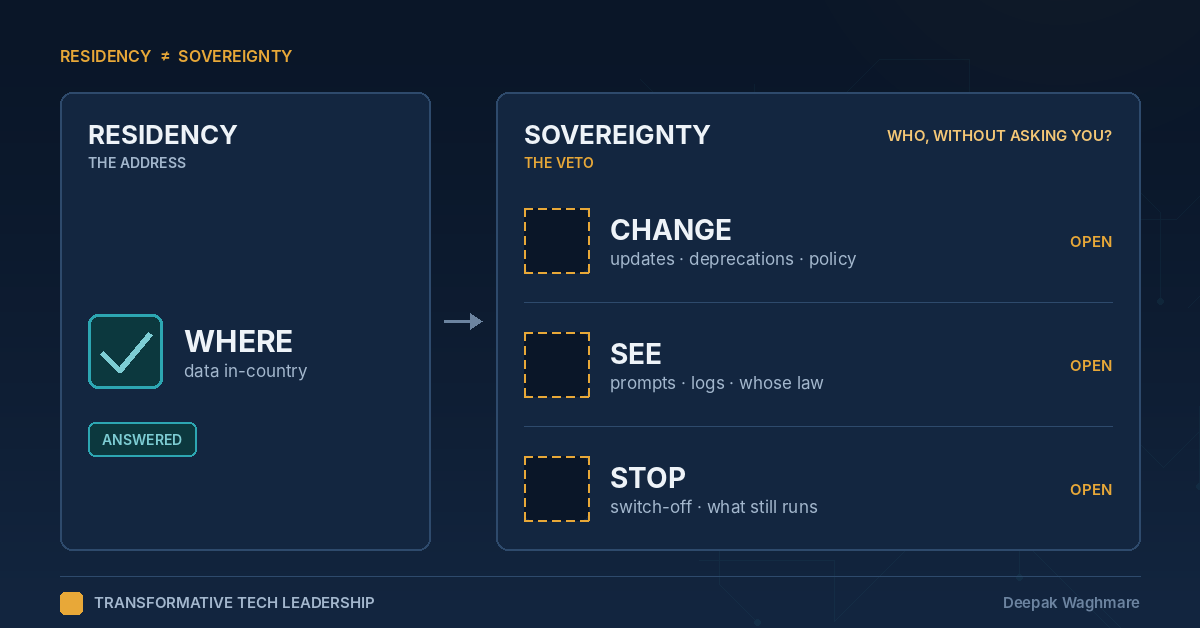
That is a more mature question than the one most of the market is still selling answers to. Data locality tells you where something is stored. It does not tell you who can reach it, who can change what it does, or who can switch it off.
Residency is an address. Sovereignty is a veto.
Data is the raw material. Process is the recipe.
For two decades, protecting enterprise IP mostly meant protecting data. Keep the records inside the perimeter, keep the perimeter inside the border, and the crown jewels were safe.
AI changes what leaves the building.
Every serious deployment pulls process into the intelligence layer. The prompt encodes the house rules. The retrieval encodes which sources count. The fine-tune is trained on how your best people decided. The agent workflow encodes the sequence, the exceptions and the escalation path.
For many organisations, that is the first time the operating model has been written down in full. It is usually written down on someone else’s stack.
That is not a data problem with a bigger perimeter. Locality can keep every record in-country while the recipe, the way the organisation actually decides, is executed, logged and improved somewhere you have no vote.
This is the context layer from my Dependency Problem edition. It is exactly the layer the residency checkmark does not reach. The customers asking about access to their processes have noticed.
The gap has a number. The risk has a date.
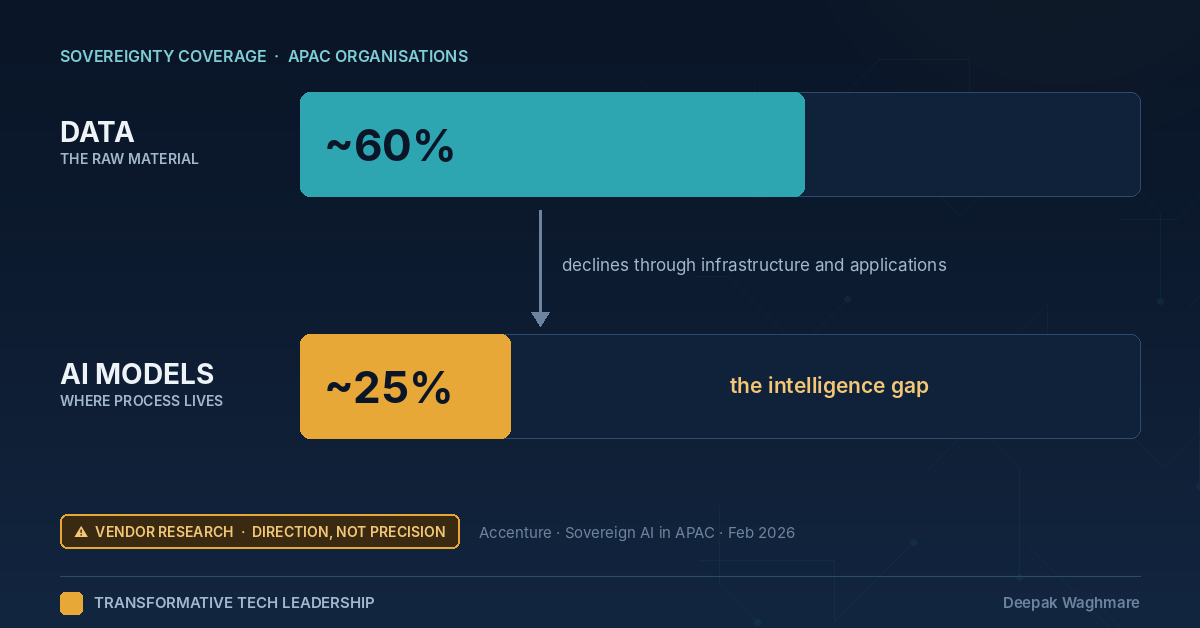
Accenture’s APAC sovereign AI research, published in February, measured the gap my customers are describing. Nearly 60% of organisations apply sovereignty requirements to their data. Coverage falls at every layer above it, and only around a quarter extend sovereignty to the AI models themselves. Accenture sells sovereign AI services, so read the figures for direction, not precision. The direction is hard to argue with.
Then June made the risk concrete.
On 12 June 2026, a US export-control directive required Anthropic to suspend access to its two most capable models for foreign nationals anywhere in the world, and the company switched them off for all customers. The directive was withdrawn on 30 June, and global access returned on 1 July.
Whatever one thinks of the decision, the mechanism is the lesson. For close to three weeks, every enterprise in this region building on those models lost them, through a decision made in a jurisdiction none of them vote in. No residency clause would have changed that outcome.
Three questions a residency clause cannot answer
The way I test sovereignty now is three questions, asked of each AI workload, not of the platform as a whole.
Who can change it without asking you? Model updates, deprecations and policy changes alter how your process behaves. If someone else controls that schedule, they control your recipe.
Who can see it, and under whose law? Prompts, retrieved context, outputs and logs are where the recipe becomes visible. Where they are stored matters less than who can compel access to them.
Who can stop it, and what still runs if they do? June answered this one, unprompted.
A workload that answers “only us” to all three is sovereign. A workload that answers “our provider” to all three is rented, and that may be exactly the right choice.
The test does not grade the answer. It makes sure someone gave one. It is also the Sovereignty ledger in the Exit Multiple, the part of the cost to leave that no invoice will ever show.
This is not an argument for bringing everything home
The tempting conclusion is to repatriate the whole stack. That is not sovereignty. It is the same unexamined decision, made in the opposite direction.
Sovereignty has a capability cost. The models you can run on a fully local footprint are not always the frontier ones, and sovereign-grade infrastructure is expensive to build and staff. The same Accenture research suggests only about a third of workloads must remain sovereign, and 57% of organisations already say they prefer a hybrid model.
The test also applies to what my own company sells. A private AI stack on your own floor can still fail it: closed weights updated on a vendor’s schedule, support delivered from another jurisdiction, telemetry nobody on your side reads.
Hardware in your own data centre is an address too.
The leadership learning
Sovereignty has no unit. Cost does.
So when a team is asked to evaluate a sovereign option, it translates the question into the only language it has: price per token, price per GPU-hour, price per seat. Translated that way, the answer is almost always to stay where you are.
The market then completes the translation by offering sovereignty as a setting. A region dropdown. A “sovereign tier.” A certificate for the board pack.
That offer is the one to decline. Not the tools, which you should use fully, but the shortcut. Deciding which of your processes must stay answerable to you, and which can safely be rented, is a statement about what the organisation is and what it can afford to lose. No checkbox makes that decision, and no region selector carries the accountability for it.
The customers I met are already past the checkmark. The open question is whether their leaders make that call deliberately, or wait for a provider, a regulator or another government to make it for them.
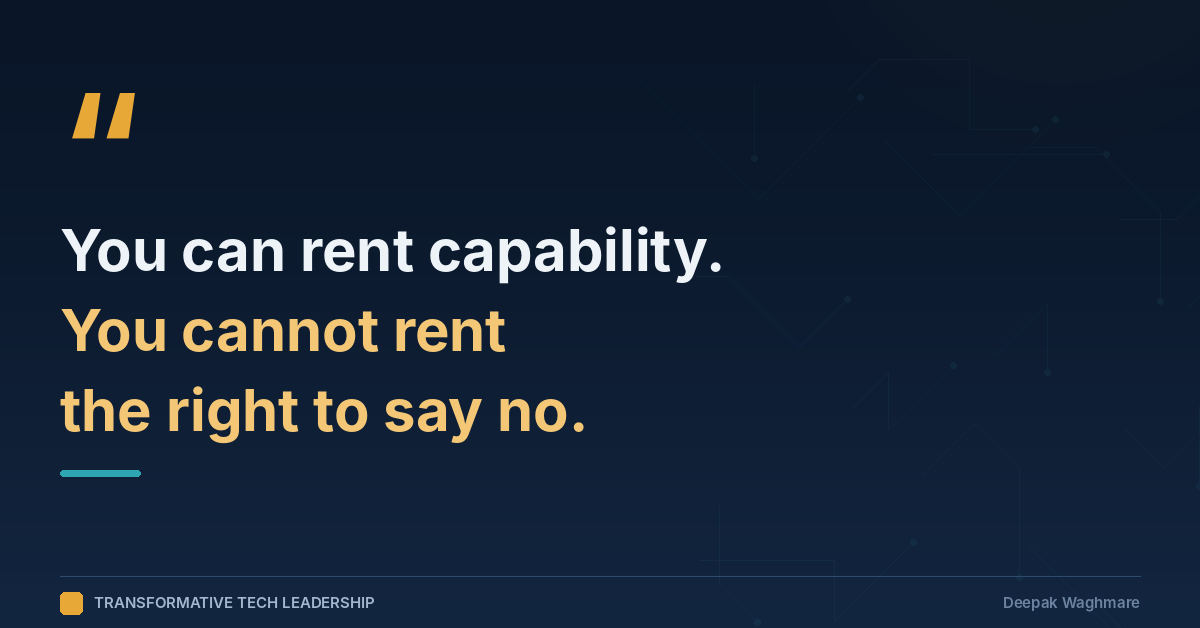
You can rent capability. You cannot rent the right to say no.
Your turn: pick your most important AI workload. Who can change it, see it, or stop it without asking you?
Sources
- Accenture, Sovereign AI: Fueling APAC’s competitive advantage, 13 February 2026
- Anthropic, Statement on the US government directive to suspend access to Fable 5 and Mythos 5, 12 June 2026
- Greenberg Traurig, AI Company Anthropic Suspends Access to Claude Fable 5, Claude Mythos 5 Following US Export Control Directive, 23 June 2026
- Digital Policy Alert, Commerce Department terminated export controls suspending Anthropic’s Claude Fable 5 and Mythos 5 models, 30 June 2026
- CASRAI, Commerce Suspended, Then Restored, Foreign Access to Anthropic’s Fable 5/Mythos 5, timeline including restoration on 1 July 2026